Intersections, Traffic & Hazards
Handle the places and surfaces where riders actually crash.
More motorcycle crashes happen at intersections than anywhere else, and most of the rest involve a surface the rider did not read in time. Study intersection strategy, passing and highway positioning, and the specific hazards — gravel, painted lines, rail tracks, grooved pavement, debris — that a car would cross without ever noticing.
The rules that matter
- Cars turning left across your path cause more motorcycle crashes than anything else — cover your brake and be ready to react at every intersection.
- Intersections are the single most likely place to crash, so slow, scan left-right-left, and never assume a waiting driver sees you.
- The center of the lane collects oil and grease, so it's the slickest strip on the road — favor a tire track instead.
- Cross railroad tracks and metal plates as close to a right angle as you safely can, so a groove can't catch your tire.
- When you pass, do it decisively in one lane change and signal early; lingering in a driver's blind spot is where you disappear.
- Keep at least a two-second following distance behind the vehicle ahead, and stretch it to four or more in rain, wind, or heavy traffic.
The lessons in this module
Each lesson is one short set of questions. If you've missed questions in this module before, a few come back at the start. Progress saves automatically; sign in only if you want cross-device sync.
Lesson videos
2 lessons · See all →Read this in the handbook
Look for these sections: Intersections, Passing, Road Hazards.
This content comes from the MSF operator manual, not a state handbook, so the rules are the same nationwide. Your state agency may add its own endorsement requirements on top.
Where these rules come from
We do not copy official handbooks — most states do not allow it. What we do instead: state the rule in our own words, then name the official document behind it. 73 questions in this module cite 4 official documents, none checked earlier than 2026-06-07.
| Official document | Sections cited |
|---|---|
Motorcycle Safety Foundation Motorcycle Operator Manual ↗ National · Checked 2026-06-14 | Crash Avoidance - Space Cushion, Handling Dangerous Surfaces - Work Zones, Intersections |
Motorcycle Safety Foundation (MSF) Rider Course ↗ National · Checked 2026-06-07 | Adverse Conditions, Highway Riding, Lane Positioning |
Federal Highway Administration / NHTSA ↗ National · Checked 2026-06-07 | Railroad Crossings, Traffic Signs — Regulatory, Warning Signs |
NHTSA Motorcycle Safety ↗ National · Checked 2026-07-28 | Rules of the road - visual scenario |
Opening a source takes you to the agency's own site, never to a copy of ours. If a source is out of date or broken, say so from any question.
Practice this module
Instantly graded questions, with the explanation behind every answer.
Keep using the focused drill, or choose Marathon to work through the full bank.
Keep practising here
The free app adds offline study and native reminders; the complete question bank remains available here on the web.


Review these questions
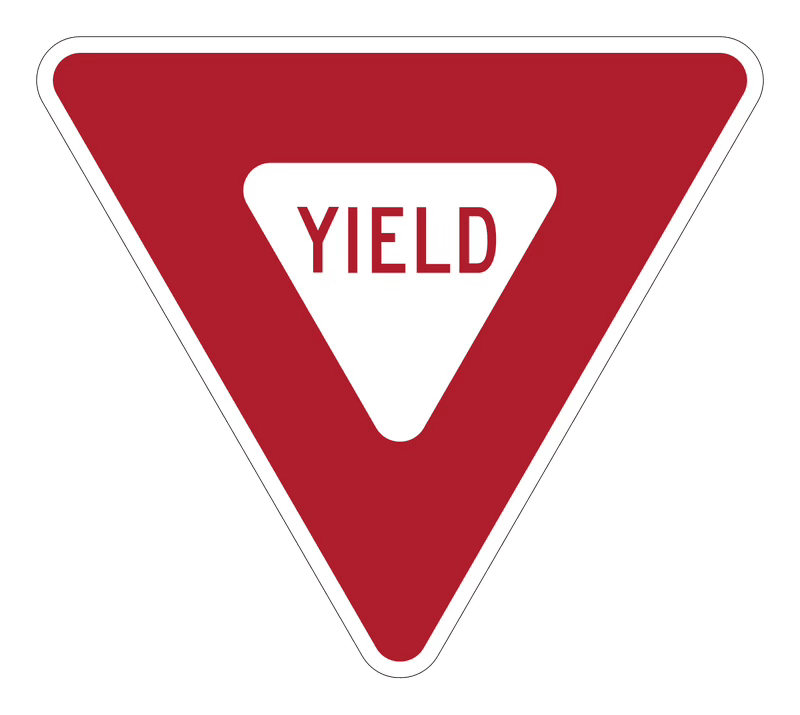
This sign requires you to:
- A. Proceed without stopping
- B. Slow down and yield to crossing traffic before entering
- C. Speed up to merge with cross traffic
- D. Stop completely
Show answer
B. Slow down and yield to crossing traffic before entering — A yield sign (red and white triangle) means slow down, look for cross traffic, and yield the right-of-way. Stop if necessary, but a full stop is not always required unless traffic is present.
Universal rule · checked against Federal Highway Administration / NHTSA — Traffic Signs — Regulatory · verified 2026-06-07
Fatigue from long highway riding is dangerous because:
- A. It reduces tire pressure
- B. Reaction time slows and the rider may stop scanning effectively
- C. It causes engine overheating
- D. It only affects riders over 50
Show answer
B. Reaction time slows and the rider may stop scanning effectively — Motorcycle riding fatigue reduces reaction time, scanning ability, and decision-making. Take breaks every 1–2 hours on long rides, and stop immediately if you feel drowsy or your concentration lapses.
Universal rule · checked against Motorcycle Safety Foundation (MSF) Rider Course — Highway Riding · verified 2026-06-07
Edge traps (where two road surfaces meet at different heights) are dangerous because:
- A. They're hard to see
- B. They make noise
- C. They slow you down
- D. The wheel can catch and unbalance you
Show answer
D. The wheel can catch and unbalance you — Edge traps can catch your front wheel, causing a crash. Cross them at a safe angle when moving from one lane to another.
Universal rule · checked against Motorcycle Safety Foundation Motorcycle Operator Manual — Ride Within Your Abilities - Handling Dangerous Surfaces · verified 2026-05-17
After a crash, the first thing you should do is:
- A. Take photos
- B. Move the motorcycle off the road
- C. Call your insurance company
- D. Check for injuries, then move to safety
Show answer
D. Check for injuries, then move to safety — First assess injuries. If able, move to a safe location away from traffic. Then call emergency services if needed.
Universal rule · checked against Motorcycle Safety Foundation Motorcycle Operator Manual — Ride Within Your Abilities - Crash Avoidance and Protective Gear · verified 2026-05-17
Before passing a vehicle on the left, check:
- A. Only your left mirror
- B. Only the rearview mirror
- C. Nothing — just go, skipping the checks that prevent a collision while passing
- D. Both mirrors, do a head check left, signal, and ensure adequate space ahead
Show answer
D. Both mirrors, do a head check left, signal, and ensure adequate space ahead — Check both mirrors, turn your head left to check the blind spot, signal, verify clear space, then pass.
Universal rule · checked against Motorcycle Safety Foundation Motorcycle Operator Manual — Ride Within Your Abilities - Lane Positions and Passing · verified 2026-05-17
