Doubles & Triples
Every input amplifies as you add trailers behind the tractor.
Adding trailers does not just make the vehicle longer, it makes it less willing to follow. A steering input at the tractor arrives at the last trailer bigger and later, which is why this endorsement is really a lesson in doing everything earlier and more gently. The other half is the air system: each trailer passes air to the one behind it, so the shut-off valves and glad hands between units decide whether the brakes at the back of the set work at all. Learn the coupling order and the valve rule together — they are the two things a set fails at.
The rules that matter
- In doubles and triples, put the most heavily loaded trailer directly behind the tractor and the lightest at the rear.
- Rearward amplification means the last trailer swings hardest — a quick correction at the tractor becomes a skid at the back of the set.
- The shut-off valves at the rear of the last trailer must be closed and open on every trailer ahead of it, or the brakes behind the open valve will not work.
- Blue glad hands carry service air and red carry emergency air; cross them and the brake pedal operates the wrong circuit.
- Check the converter dolly's locking jaws are closed around the kingpin, with no gap between the dolly plate and the trailer apron.
The lessons in this module
Each lesson is one short set of questions. If you've missed questions in this module before, a few come back at the start. Progress saves automatically; sign in only if you want cross-device sync.
Lesson videos
1 lesson · See all →Read this in the handbook
Look for these sections: Doubles and Triples.
This content comes from the federal FMCSA regulations (49 CFR), not a state handbook, so the rules are the same nationwide. Your state agency may add its own endorsement requirements on top.
Where these rules come from
We do not copy official handbooks — most states do not allow it. What we do instead: state the rule in our own words, then name the official document behind it. 101 questions in this module cite 6 official documents, none checked earlier than 2026-05-17.
| Official document | Sections cited |
|---|---|
FMCSA Commercial Driver License Manual ↗ National · Checked 2026-08-08 | Section 7: Doubles and Triples |
FMCSA CDL Testing System — Doubles/Triples ↗ National · Checked 2026-06-30 | Doubles and Triples — Brake Testing, Doubles and Triples — Converter Dolly, Doubles and Triples — Coupling |
FMCSA Commercial Driver License Manual ↗ National · Checked 2026-05-17 | Section 7: Doubles and Triples |
FMCSA Commercial Driver's License Manual ↗ National · Checked 2026-06-14 | Section 7 - Doubles and Triples, Section 7.1 - Managing Space With Doubles, Section 7.1 - Pulling Double/Triple Trailers |
49 CFR 383 ↗ National · Checked 2026-08-01 | Section 7: Doubles and Triples |
FMCSA Commercial Driver License Manual ↗ National · Checked 2026-06-08 | Doubles and triples handling |
Opening a source takes you to the agency's own site, never to a copy of ours. If a source is out of date or broken, say so from any question.
Practice this module
Instantly graded questions, with the explanation behind every answer.
Keep using the focused drill, or choose Marathon to work through the full bank.
Keep practising here
The free app adds offline study and native reminders; the complete question bank remains available here on the web.


Review these questions
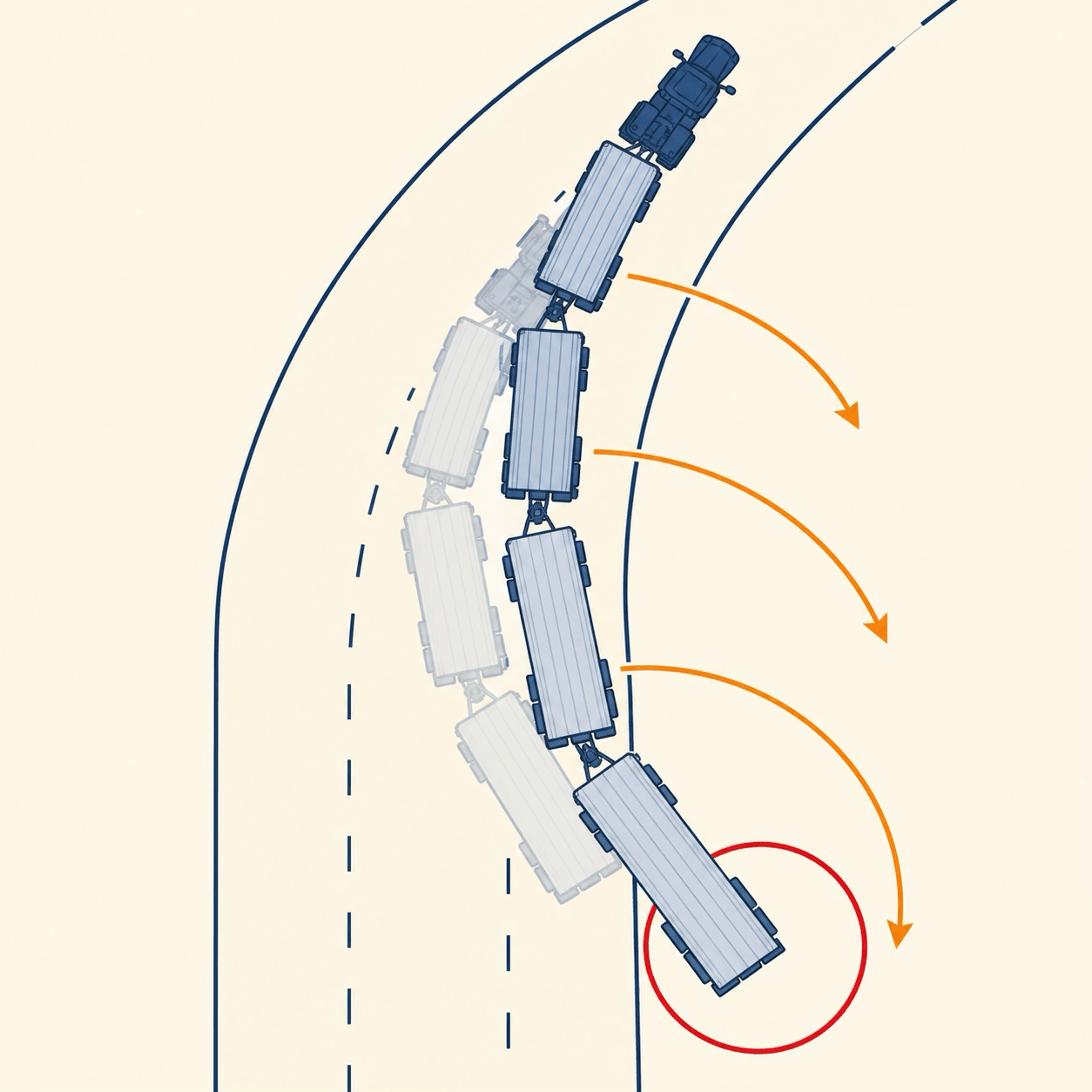
In the doubles combination shown, a quick steering move affects the rear trailer:
- A. Only in reverse
- B. Least — it dampens motion
- C. Not at all
- D. Most severely because of rearward amplification
Show answer
D. Most severely because of rearward amplification — Rearward amplification makes each trailing unit swing wider than the one ahead; abrupt steering that the tractor tolerates can flip the rear trailer of doubles.
Universal rule · checked against FMCSA Commercial Driver's License Manual — Section 7 - Doubles and Triples · verified 2026-06-14
What should a driver do if a trailer in the set begins to skid?
- A. Ease off and stop braking hard
- B. Brake harder to straighten it
- C. Accelerate to pull it back
- D. Steer sharply the other way
Show answer
A. Ease off and stop braking hard — Locked wheels cannot steer, so releasing the brakes lets the trailer regain grip and fall back into line.
Universal rule · checked against FMCSA Commercial Driver License Manual — Section 7: Doubles and Triples · verified 2026-07-30
When uncoupling the rear trailer of a double, you should:
- A. Just pull forward quickly
- B. Lower the dolly landing gear before disconnecting
- C. Leave the dolly attached to the front trailer
- D. Release all air brakes first
Show answer
C. Leave the dolly attached to the front trailer — Keep the dolly attached to the front trailer when uncoupling the rear trailer — pull the tractor, front trailer, and dolly forward together to pull the dolly out from under the rear trailer.
Universal rule · checked against FMCSA Commercial Driver License Manual — Section 7: Doubles and Triples · verified 2026-05-17
How does a set of doubles behave in a strong crosswind compared with a single trailer?
- A. It becomes noticeably more stable
- B. It is pushed sideways more easily
- C. It stops in a shorter distance
- D. It steers with less effort
Show answer
B. It is pushed sideways more easily — Two tall boxes give the wind more surface to push, and the rear trailer reacts most, so slow down and correct with small steady inputs.
Universal rule · checked against FMCSA Commercial Driver License Manual — Section 7: Doubles and Triples · verified 2026-07-29
Before coupling a converter dolly, the dolly's brakes should be:
- A. Applied only after the pin is set
- B. Left released so it rolls freely
- C. Removed for the coupling step
- D. Locked by charging its air tank
Show answer
D. Locked by charging its air tank — Charging the dolly air tank locks its wheels so it cannot roll while you back under it. An unsecured dolly moves as the trailer touches it.
Universal rule · checked against FMCSA Commercial Driver License Manual — Section 7: Doubles and Triples · verified 2026-07-29
